Big World: How I Built My First Django Project using WSL and Ubuntu

On one hand, I love my Windows setup. It’s where my games are, where my Adobe apps live, and where I feel comfortable. On the other hand, every tutorial I watched for backend web development seemed to scream: “You need Linux.”

I wanted to learn Django, the powerful Python framework, but setting it up natively on Windows felt like swimming upstream.

Then I found the bridge: WSL (Windows Subsystem for Linux).

Step 1: Opening the Portal (Installing WSL)

If you haven’t used WSL yet, it feels a bit like magic. It allows you to run a full Linux terminal directly inside Windows. No rebooting, no lag.

I remember opening PowerShell and typing the command that started it all:

wsl –install

My first project wasn’t anything fancy—just a simple blog backend—but the setup taught me more than the code did.

One of the first hurdles was realizing that Ubuntu comes with Python, but usually not the pip (package installer) setup you need immediately. I learned the hard way that you should never mess with the system Python.

I learned the golden rule of Python development: Always use a Virtual Environment.

Bash

# Installing the tools
sudo apt update
sudo apt install python3-pip python3-venv

# Creating my project sanctuary
python3 -m venv my_first_project_env
source my_first_project_env/bin/activate


Below screenshot is how i keep my notes for reference
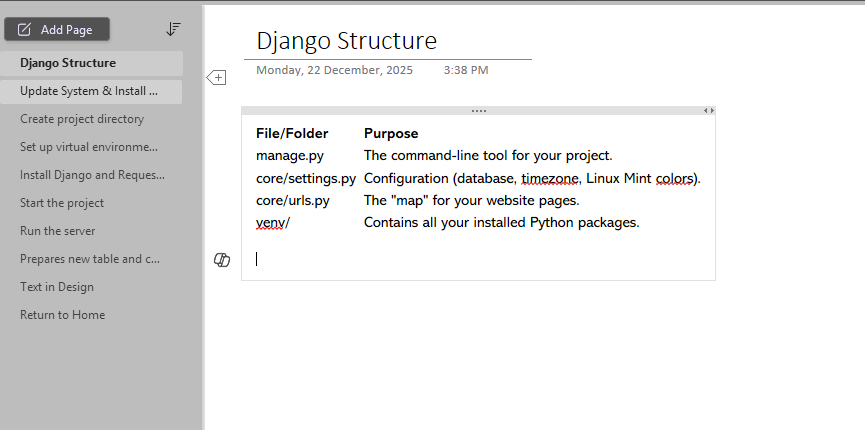
Installing the tools

sudo apt update
sudo apt install python3-pip python3-venv

Creating my project sanctuary

python3 -m venv my_first_project_env
source my_first_project_env/bin/activate

Seeing that little (my_first_project_env) appear next to my cursor was a small victory. It meant I had a sandbox. I couldn’t break my computer even if I tried.

Step 3: Summoning Django

With the environment active, installing Django was a breeze.

Bash

pip install django

Then came the moment of truth. I navigated to my project folder and ran the command to start the project. This is where WSL shines—the file system integration. I could code in VS Code on Windows, while the code actually ran inside the Ubuntu terminal.

I typed:

Bash

django-admin startproject myblog
cd myblog
python3 manage.py runserver

I switched to my browser (Chrome on Windows) and typed in localhost:8000.

The “It Worked!” Moment

If you’ve ever learned Django, you know the screen. The little rocket ship. The text saying “The install worked successfully! Congratulations!”

A Side Note: The “One Click Settle” Envy (Laravel Herd)

While I am proud of learning the command line, I have to admit—sometimes I look at the PHP world with a bit of jealousy.

After finishing my Django setup, I discovered Laravel Herd. If you are into the PHP/Laravel ecosystem, you don’t even need to touch the terminal to get started. It’s basically a “one click settle” solution. You install it, and boom—you have a fast, native development environment ready to go. No sudo apt update, no configuring ports, just instant coding.

It made me realize how diverse the dev world is.

  • WSL is for when you want to understand the engine, get your hands dirty with Linux, and have full control over your Python/Django environment.
  • Laravel Herd is for when you just want to drive the car without opening the hood.

Both are valid, but for my Python journey, taking the “scenic route” with WSL gave me confidence that a one-click installer never could.

Tips for IT Network & Infrastructure Students: How to Stand Out and Succeed

If you’re planning to apply for an internship in IT networking or infrastructure, you’re already on the right track. The industry is always looking for people who understand networks, servers, security, and real-world troubleshooting. But the competition can be tough—so how do you stand out?

Here are the best tips to help you prepare, impress during interviews, and perform confidently during your internship.

Please choose where to do your IT networking or infrastructure internship, many students aim for government agencies because they sound stable and prestigious. However, if your main goal is learning, hands-on experience, and skill development, an SI company is often the better choice.

System integrators handle:

  • Real client projects
  • Network deployments (Here where my skills when i need to replace current network switch where i learn how to read command)
  • Firewall setups
  • Server migrations
  • Troubleshooting across different environments

You’ll get more chances to touch real systems compared to government offices, where interns may only assist with basic tasks.

Many SI companies are partners with vendors like:

  • Fortinet
  • Cisco
  • VMware
  • Microsoft
  • Dell
  • HP

Interns often get access to training or at least exposure to enterprise tools you won’t usually see in government environments.

Government internships often involve:

  • Paperwork
  • Documentation
  • Basic helpdesk tasks

Meanwhile, SIs are technical by nature — meaning most of what you do directly relates to IT networking or infrastructure.

When you perform well during your internship, you increase your chances of being absorbed into the company. Based on my own experience, many companies—especially SI (System Integrator) companies—tend to offer full-time positions to interns if:

  • They see strong potential
  • They have available openings
  • You show good attitude and willingness to learn
  • You can work independently with proper guidance
  • You contribute value to the team
  • You show reliability and professionalism

Internships are not just for learning—they are also a trial period where the company gets to know you, your work habits, and how well you fit into their environment. If you consistently show initiative, ask good questions, and handle tasks responsibly, you become a strong candidate for a permanent role.

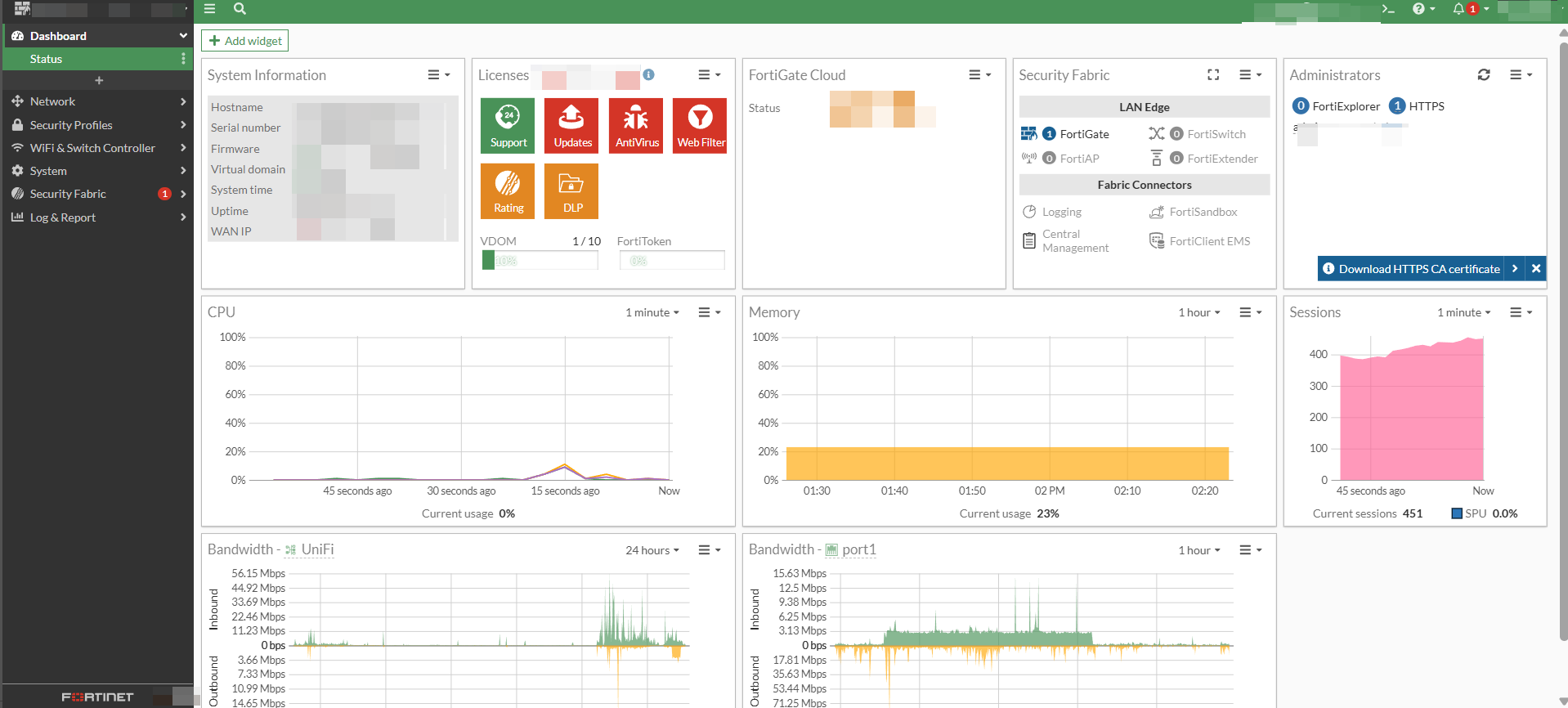
FortiGate Firewall? Why i love this firewall

FortiGate is a popular firewall appliance developed by Fortinet, designed to protect networks from cyberattacks, unauthorized access, and harmful traffic. It’s widely used in businesses of all sizes—from small offices to large enterprises—because of its strong security features, fast performance, and easy management

First thing is fortigate dashboard is very easy to understand. Can configure WAN with PPPOE which in Malaysia required vlan 500 for sub interface. There is one Firewall that cannot make direct sub-inferface vlan but that model is very good.

Pricing for fortigate + subscription is not very high which is good for small business to protect its internal network

Fortigate is not only Firewall available in commercial but got other brand

Key Features of FortiGate

  1. Firewall & Access Control

Allows or blocks network traffic based on rules you create.

  1. Intrusion Prevention System (IPS)

Detects attacks and blocks them before they reach your devices.

  1. Web Filtering

Controls access to websites by categories (e.g., social media, gambling, adult content, streaming, etc.).

  1. Antivirus & Malware Protection

Scans network traffic to prevent harmful files from entering the network.

  1. VPN Support

FortiGate supports:

SSL VPN

IPSec VPN

Useful for remote workers connecting securely to the office.

  1. SD-WAN

Helps balance multiple internet connections and improve network performance.

What Is a Firewall? A Simple Explanation for Beginners

A firewall is a security system that controls the network traffic entering or leaving a device, server, or network. Its main job is to protect your system from unwanted access, cyberattacks, and malicious activities by allowing only safe and approved connections.

Think of a firewall as a security guard—it checks every “visitor” (data packet) and decides whether to allow or block it based on rules.

Why a Firewall Is Important

  1. Protects Against Unauthorized Access

Firewalls block attackers who try to break into your network or servers.

  1. Filters Malicious Traffic

Suspicious or harmful traffic (viruses, malware, scans) can be stopped before reaching your device.

  1. Controls Network Usage

Admins can define rules to:

Allow or deny specific ports

Limit access to certain websites

Restrict certain apps or services

  1. Maintains Privacy

Firewalls help keep your internal network hidden from the public internet.

Did you know, Sophos provide Free Firewall Home Edition ?

They provide Software appliance that can be installed on a dedicated Intel™ – compatible PC.

  • No subscription needed
  • Lightweight and doesn’t slow down the PC
  • Beginner-friendly but still has advanced options
  • More visibility than the default Windows firewall
  • Good for privacy-conscious users


Alternative for Free you may check with Open Source

  • pfSense
  • OPNsense – zenarmor can be integrated with the firewall to give you more advanced protection.

Proxmox Datacenter Manager: Centralized Control for Modern Virtual Infrastructures

Proxmox Datacenter Manager is a centralized open-source management solution for distributed infrastructures. With its unified web interface you can easily monitor and control multiple Proxmox remotes, see health and performance at a glance, and coordinate key operations across clusters and data centers.

I found this software on this link it seems like, Proxmox want to follow VMware to manage all VM / Host in one device

Proxmox also mention that Customers with active Enterprise Support for their Proxmox remotes also gain access to Proxmox Datacenter Manager updates and support.

2025 so many new technology need to be explorer. IT keep growing seems too fast for me to catch it up.